
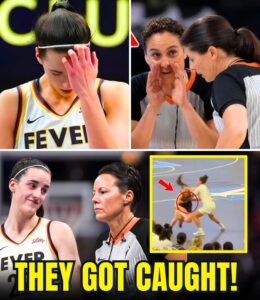
The WNBA is under fire—again. But this time, it’s not about viewership, marketing, or salaries. It’s something far more fundamental: fairness. The spark? New, crystal-clear footage that reveals just how badly officials blew a critical call involving rookie sensation Caitlin Clark. And now, fans, analysts, and even neutral observers are sounding the alarm: this isn’t just one bad call—it’s a full-blown officiating crisis that threatens to shake the foundation of the league at its most pivotal moment.
🔥 The Play That Ignited the Firestorm
During a preseason matchup, Caitlin Clark was whistled for an offensive foul after contact with opposing guard Te-Hina Paopao. At first glance, it looked like a standard push-off. But then another camera angle surfaced—and the narrative flipped on its head.
The footage shows Paopao clearly grabbing and clutching Clark’s jersey, even twisting the fabric with both hands as Clark attempted to drive past. Clark’s arm extension—initially cited by the refs as the reason for the foul—looks far more like a reaction to being illegally held back than any deliberate attempt to gain an unfair advantage.
The call wasn’t just wrong. It was completely backward.
😱 Fans & Analysts Outraged: “One of the Worst Missed Calls in Basketball History”
The internet erupted. Former players, journalists, and even rival fanbases were united in disbelief. “This isn’t just a bad call,” one analyst tweeted, “this is officiating malpractice.” Others called it “embarrassing,” “inexcusable,” and “proof that Clark is playing under a different rulebook than everyone else.”
Clark’s defenders point to the footage: Paopao grabbing her jersey with both hands, Clark already a step ahead, and the clear lack of balance from the defender who overcommitted and threw herself out of position. The video makes one thing crystal clear: this should have been a defensive foul.
🎯 The Bigger Problem: A Pattern of Targeted Officiating?
Here’s where it gets more disturbing: this isn’t an isolated incident. In game after game, Clark has been hit, grabbed, shoved, even eye-poked—with no whistles from the officials. Meanwhile, she’s getting called for offensive fouls on minimal contact.
It’s not just Clark. Other stars like A’ja Wilson and Diana Taurasi have also spoken out about inconsistent calls. But when it comes to Clark, the whistle seems to be even more reluctant—until it’s time to penalize her.
“Why does it feel like Caitlin Clark is being officiated by a completely different standard?” asked one ESPN commentator. “She gets hacked with no call, then breathes on someone and it’s a foul.”
📉 The Cost: More Than Just One Call
Make no mistake—bad officiating affects more than box scores. It undermines the flow of the game, frustrates players, and leaves fans questioning what they’re watching. And when the league is finally in the spotlight—thanks to new talent, expanded TV deals, and surging popularity—this kind of inconsistency is dangerous.
The Caitlin Clark incident is just the tip of the iceberg. Other moments from the same game saw players getting tackled, jersey-grabbed, slapped on the arms—with no calls at all. Meanwhile, phantom fouls—where no contact even occurred—were being whistled on the other end.
Even more damning? Reports are surfacing of referees with reputations for “game management” rather than fairness—swinging momentum based on feel rather than fact. Some have even earned nicknames like “The MJ Ref” for their ability to decide games with a whistle.
🚨 WNBA at a Crossroads: Fix Officiating or Risk Relevance
With the league finally capturing national attention, it cannot afford to let the product on the floor be overshadowed by officiating blunders. Clark, Boston, Reese, and others are breathing new life into the WNBA—but no level of talent can fix a credibility problem.
Referees are human. Mistakes happen. But when mistakes become patterns, and patterns start to look like bias, it’s time for leadership to act.
The league owes it to its players—and its fans—to get this right. The future of the WNBA depends on it.
Bottom line: The new footage didn’t just exonerate Caitlin Clark—it exposed something far more damning. The WNBA has an officiating crisis, and it’s no longer just a talking point. It’s a threat to the integrity of the game.
The ball’s in your court, WNBA. What are you going to do about it?
News
Cynthia Cooper DESTROYS Cheryl Swoopes in Explosive New Interview — Defends Caitlin Clark, Calls Out Haters
It wasn’t subtle. It wasn’t soft. It wasn’t even shaded. When Cynthia Cooper stepped into the spotlight for her recent…
🚨BREAKING: SHOCK COURTSIDE FOOTAGE BLOWS LID OFF WNBA SCANDAL – Was Caitlin Clark Targeted? New Evidence EXPOSES the League’s Hidden Agenda!🚨
In a jaw-dropping development that’s shaking the foundation of women’s basketball, exclusive courtside footage has emerged that may forever change…

Elon Musk’s Latest Investor Power Play Just Made Suing Tesla Nearly Impossible
As soon as Tesla shifted its incorporation to Texas, they made the change to avoid getting hit by lawsuits from…
BREAKING: Diamond DeShields FIRED After Caitlin Clark Incident – WNBA Sends Clear Message to Bullies!
In a shocking development, Diamond DeShields has officially been let go from the WNBA following her controversial attack on Caitlin…
Zuckerberg Is Hiding Alien Evidence, Insiders Claim — The Real Reason Will Blow Your Mind
Mark Zuckerberg© Bloomberg via Getty Images Facebook founder Mark Zuckerberg allegedly has proof of intelligent life in the Universe – but is…
Kanye West’s song gets 10 million views on Twitter after being banned by YouTube, Spotify and Apple Music ; Elon Musk slammed for …
Kanye West’s song gets 10 million views on Twitter after being banned by YouTube, Spotify and Apple Music ; Elon…
End of content
No more pages to load